
The Happy Man Tree and the High Holy Days by Cath Goldstein
August 28, 2020
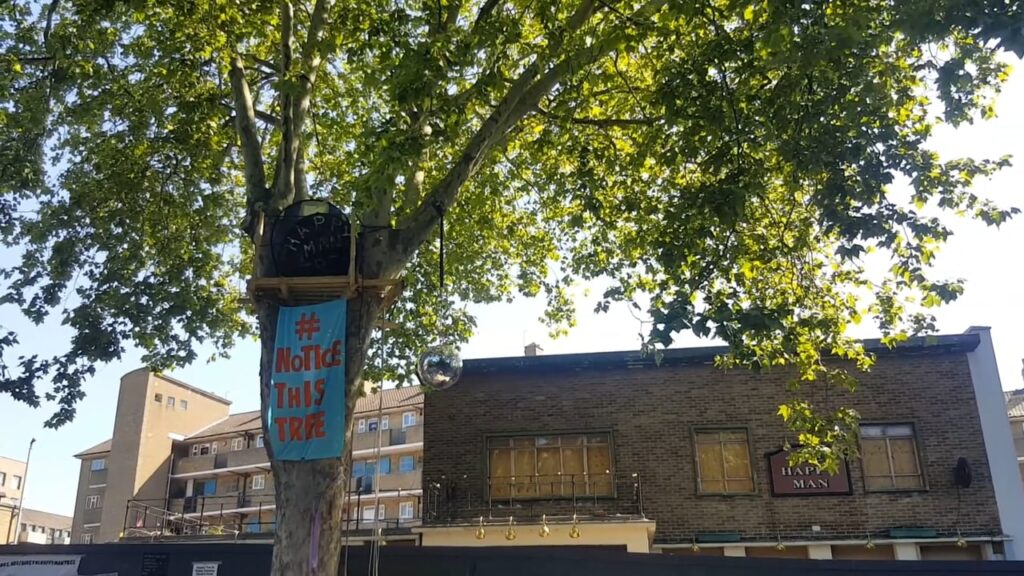
I stand by the Happy Man Tree, a large and beautiful London plane tree, growing on a pavement in Stoke Newington, named after a pub it stood next to.
The trunk is wide, too wide for my arms to pass around. The canopy stretches out far and wide, its lower limbs hanging towards the ground, as is the London planes’ particular way of growing.
There is currently a fight to keep this healthy street tree from being destroyed. The fight is between Hackney Council/Berkeley homes, and local people. Many many mature trees have already been cut down to make way for the dense high-rise redevelopment of Woodberry Down Estate, built around a profitable idea of “nature“ and “healthy living“. The hoardings show larger-than-life photographs of a heron, say, or close-up “natural scenes” on the East and West reservoirs below the new development.
The existence of these reservoirs is due to the successful outcome of a fierce local campaign to save them. Between 1986 and 1999 the ‘Save the Stoke Newington Reservoirs and Filter Beds Campaign’ worked tirelessly to prevent the site being sold off for building development. Now ironically, the reservoirs’ ecosystem is being made use of, to market the new housing development, called Woodberry Park.
The old blocks in Woodberry Down Estate, the rundown ones, were originally built with it seems, the community in mind. Each one had a large amount of space around it. Some of this is used for car parks now but behind each block there are green spaces – communal gardens.
When the estate was built, 20 of the 64 acres were designated playgrounds, tennis courts and a community centre.
The best way to picture what is going on is by imagining a patch of grass in the middle of an athletics track, which normally comes to 1 hectare. Before regeneration, about 83 homes were on each of these grass patches. By 2013 they announced it would be 224 homes on each hectare! By 2031, 2000 council homes will be replaced by 5500 homes.
The strips of green space, hugely valued, are not being replaced as the old blocks come down, and new ones go up. On many of these green spaces huge old trees stood, hundreds of which have disappeared, been built over.
A Happy Man Tree symbolises a hugely important theme and is in some ways the last straw, the last of many mature trees here.
It is busily absorbing pollution, while it miraculously produces food from sunlight, and pumps out oxygen for us to breathe. The extensive canopy is dwarfed by modern high-rise glass and steel cuboids rising to the sky. High, fast winds catch on these large monoliths sending them flying down the sheer sides, creating unpleasant wind tunnels at street levels. The ‘replacement’ trees languish and slowly die in their fancy containers, neither being watered or nourished, wind swept.
What is going on here?
And what has all this got to do with the High Holy Days I hear you ask?
The big idea of the High Holy Days is “Teshuva“ from the word “return“ or “turn”.
Turning back to the path of righteousness.
The David and Goliath story of the Happy Man Tree begs us to look at what is going on here, and how does this reflect to us how we live now? We are asked to engage in a process of moral self assessment, seeking forgiveness, being humble, making amends, resolving to do better.
Most of us haven’t murdered someone or stolen our best friends dog this year.
But where have we allowed things to happen and not done anything about it? Where have we given up on changing our lives around to make the world a better place?
Our present societies encourage us to allow profit to take precedence over our planetary and human needs. They seek to present individualism as preferable to community. We have cut down trees for convenience which is a metaphor for a wider ailment.
Let us spend some time considering this.
What have we awarely or unawarely been complicit in allowing to happen?
What symbolic trees have we allowed to be cut down?
During this important time of returning, Teshuva, we get another chance to consider, what is our collective responsibility?
To our community? To our world?
G’mar Hatima Tova, and
Long live the Happy Man Tree!